Hiragana Lessons
Japanese writing systems
There are 46 hiragana characters for 46 different sounds. Hiragana are used for expressing "grammatical" elements such as particles, and endings of adjectives and verbs which show tenses, etc. Kanji are used for expressing "meaningful" elements such as nouns and stems of adjectives and verbs.
It is possible to write entire Japanese sentences in hiragana. If an adult forgets certain kanji which are rarely used, he/she may substitute hiragana for them. Since the basic 46 hiragana symbols and some modifications of the suffice for all Japanese sounds, Japanese children start to read and write Japanese all in hiragana before making an attempt to learn some of the two thousand kanji currently used.
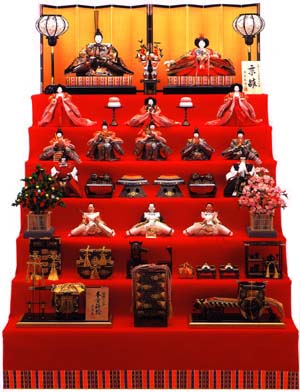
Hinamatsuri (Doll's Festival)
"Hinamatsuri (Doll's Festival)" is held on March 3rd. This is a day to pray for young girl's growth and happiness. It is also called "Momo no sekku (Peach Festival)" because of the peach blossom season on the old lunar calendar. May 5th is "Kodomo no hi(Children's Day)," and this is so called "Boy's Festival." While Children's Day is a national holiday, Hinamatsuri is not.
Most families with girls display "hina-ningyo" (special dolls for Hinamatsuri, see the photo below) and dedicate peach blossoms to them. They are usually arranged on a five or seven-tiered stand covered with a red carpet. At the top are the Emperor and Empress. The next step contains three court ladies (sannin-kanjo), followed by five musicians (gonin-bayashi), two ministers (udaijin and sadaijin), and three servants ending the bottom row in a five-tiered display. There are also small pieces of furniture, small meal dishes, and other things.
Click here to learn about the origin of Hinamatsuri and Hinamatusri song.
| Kozutsumi (小鼓) - Hand drum |
| Fue (笛) - Flute |
| Utaikata (謡い方) - A singer * He has a folding fan (sensu). |
Zuishiin (随身) - Two Ministers | |
| Udaijin (右大臣) - The Minister of the Right |
| Sadaijin (左大臣) - The Minister of the Left * The left was considered superior in the old Japanese court, therefore an elder man known of his wisdom was often chosen for this position. This is why a sadaijin doll has a long white beard, and looks older than a udaijin doll. |
Other Items | |
| Ukon no tachibana (右近の橘) - A mandarin orange tree. * It was always planted to the right in the old Japanese court. |
| Sakon no sakura (左近の桜) - A cherry tree. * It was always planted to the left in the old Japanese court. Since this is a Peach Festival, it is often substituted with a peach tree. |


